

Commentary
Issam Kayssi
{
  "authors": [
    "Issam Kayssi"
  ],
  "type": "commentary",
  "blog": "Diwan",
  "centerAffiliationAll": "",
  "centers": [
    "Carnegie Endowment for International Peace",
    "Malcolm H. Kerr Carnegie Middle East Center"
  ],
  "englishNewsletterAll": "",
  "nonEnglishNewsletterAll": "",
  "primaryCenter": "Malcolm H. Kerr Carnegie Middle East Center",
  "programAffiliation": "",
  "regions": [
    "Lebanon",
    "Levant",
    "Israel"
  ]
}
Source: Getty
Israel is encroaching on the country’s territory, while the Lebanese look askance at one another.
Lebanon today is not quite in a full-scale war, but it is certainly not at peace. Israeli airstrikes are continuing. Hezbollah is firing rockets and launching drones. Israeli evacuation orders are expanding daily to include more Lebanese towns. Villages in the south and the Beqaa Valley stand empty of inhabitants. Israeli surveillance and attack drones circle overhead everywhere, including Beirut, while people are striving to go about their lives despite the din and the danger.
One result of this continued instability is the gradual remapping of Lebanon, which has in practice shrunk by hundreds of square kilometers from its much-heralded 10,452 square-kilometer area. Entire stretches of the country now exist in varying states of military occupation, latent danger, depopulation, or abandonment. More worrisome is the fact that social barriers have sprung up across the country. These are not marked by physical boundaries, checkpoints, or official decrees. They are invisible—taking the form of patterns of avoidance, hesitation, and suspicion among Lebanese of different communities.
The beginning—now easily half-forgotten—of Lebanon’s latest unstable chapter came on October 8, 2023, when Hezbollah opened a “support front” against Israel a day after Hamas’s attack against the Jewish state. Israel returned fire. For the rest of 2023, the conflict appeared geographically intelligible. The fighting was confined to the south of Lebanon. There remained, at least in theory, a recognizable battle line separating the arena of war from that of non-war. Beirut watched from a distance; the Lebanese government seemed to assume (as Hezbollah did) that the confrontation would remain calibrated.
That assumption did not survive 2024. By the summer of that year, Israel sharply escalated its operations in Lebanon, transitioning to a full-scale war targeting Hezbollah—including its leadership, from field commanders up to the seniormost figures. The Beqaa and Beirut, both well beyond the south, were repeatedly struck. By the fall, the war had become a national condition, reaching even the far north of the country.
The U.S.-brokered ceasefire between Lebanon and Israel on November 27, 2024, may have officially paused the conflict, but it did not usher in stability. On paper, the arrangement was meant to halt hostilities and facilitate Hezbollah’s disarmament by the Lebanese state. For fifteen months, a significantly weakened Hezbollah held its fire but quietly rebuilt its capabilities, even as the Lebanese Army dismantled some of its arms depots south of the Litani River. Meanwhile, Israel continued striking people and places throughout Lebanon under the justification, it claimed, of enforcing the agreement. Israeli forces also retained control of several hilltops in Lebanese territory along the southern border. Lebanon was in an uneasy limbo in which full-scale war had subsided, but the possibility of its reemergence remained perpetually present.
Then came March 2, 2026, when Hezbollah launched rockets into northern Israel, openly joining in Tehran’s defense amid the U.S.-Israeli military campaign against the Islamic Republic. The ensuing confrontation killed and injured thousands in Lebanon. Subsequently, a new U.S.-brokered ceasefire between Lebanon and Israel, which took effect on April 17, altered Lebanese geography a step further.
Israel established a so-called “yellow line” inside Lebanon, beyond which it was forbidden to cross. In doing so, it occupied 608 square kilometers along the border (approximately 6 percent of Lebanese territory) and turned dozens of villages into militarized “buffer zones.” Claiming that they housed Hezbollah tunnels and infrastructure, Israeli forces razed many of these villages, rendering them uninhabitable. On the morning of April 17, the day the ceasefire went into effect, Israel reissued evacuation orders for the entire area south of the Litani (about 1,000 square kilometers), which was already cut off from the rest of the country owing to Israel’s destruction of bridges. Since then, the orders have gradually expanded to towns north of the Litani as well as into parts of the Beqaa.
The prevailing understanding in Lebanon today is that Washington is restraining Israel from resuming its campaign in the rest of the country, including Beirut and the Shiite-majority southern suburbs of Beirut. (The latter, in which Hezbollah maintains a strong political and security presence, saw hundreds of thousands of residents flee between March 2 and April 16, due to Israeli warnings and attacks.) But on May 6, Israel struck the southern suburbs for the first time since the onset of the ceasefire, assassinating a senior Hezbollah Radwan forces commander. This should not have come as a surprise; Israel made it clear in March that it viewed predominantly Shiite areas not simply as civilian spaces, but as environments within which Hezbollah’s infrastructure and personnel were embedded.
As a result, residents who fled the suburbs, or even southern towns located north of the Litani, fear returning to their homes despite the April ceasefire. Indeed, the two areas, in addition to the largely off-limits region south of the Litani, are increasingly treated as battle-spaces. Many people assume—reasonably enough—that any area associated with Hezbollah will become a target once again, and that demonstrably unsafe zones cannot possibly become safe overnight.
Yet Lebanon is not merely undergoing geographic change and demographic upheaval. For the Lebanese today, the frontline has taken on an additional form. It is no longer only a boundary between warring factions. There is another frontline, one that has diffused into a sort of social logic through which places, communities, and even individuals are assigned varying degrees of perceived security risk.
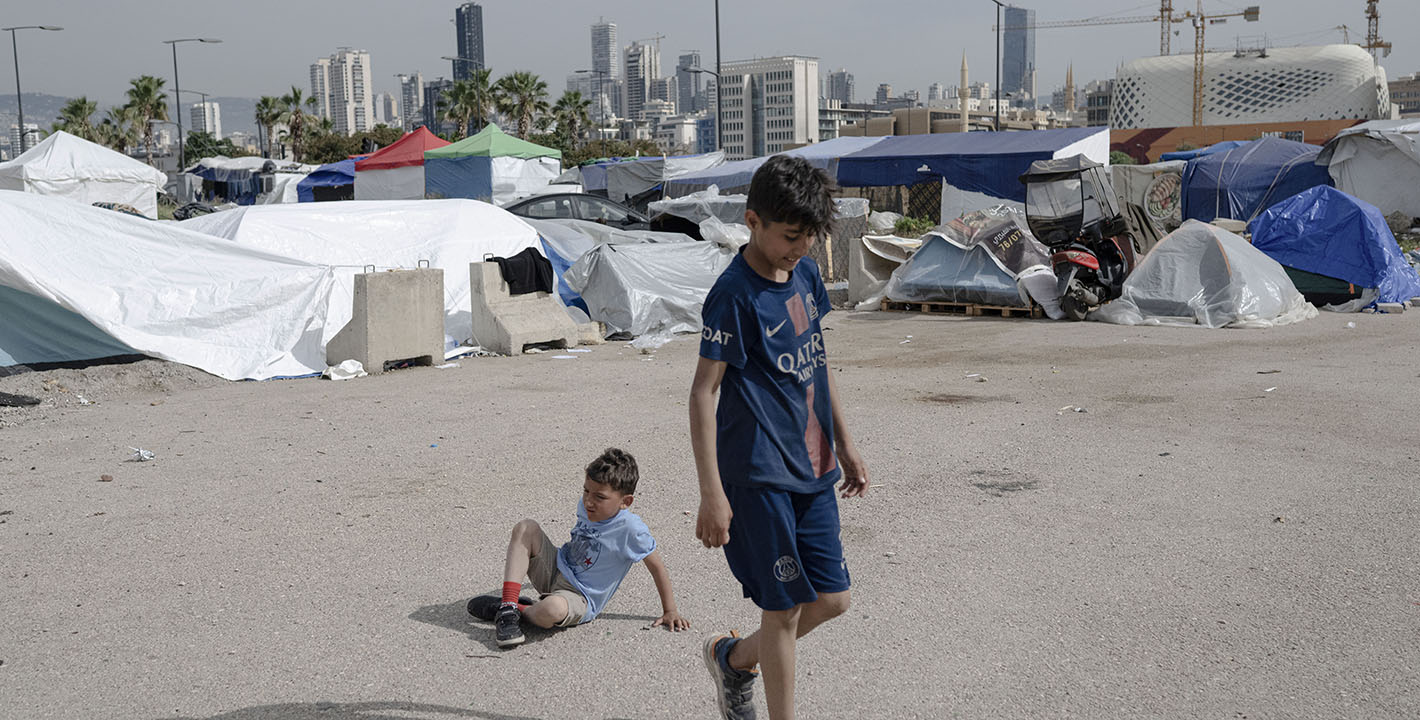
As displaced Shiite families moved into areas populated largely by members of other sectarian denominations, many Lebanese quietly began calculating risk in communal terms. This was rarely expressed openly, given that employing sectarian language is considered crude in polite society. It appeared instead through euphemism and caution. Landlords would ask indirect questions of prospective tenants. Residents would remain wary of those moving into their buildings. Communities would fear that hosting displaced families could inadvertently expose their neighborhoods to Israeli targeting. Over time, these assumptions reshaped behavior. Social visits changed. Daily routes were adjusted for the purpose of avoiding areas perceived as vulnerable. Sectarian identity became securitized.
To be sure, Lebanon’s geography has always had a sectarian tinge. Neighborhoods, towns, and regions have long carried communal identities. But the Hezbollah-Israel conflict is producing something more corrosive: the transformation of those identities into perceived categories of security risk. This matters because the current conflict is not only ending lives and livelihoods; it is also altering the way that surviving communities inhabit space. Lebanon’s current state of ambiguity, if further prolonged, may prove as socially reconfiguring as open warfare.
On May 14, Lebanese and Israeli representatives met in Washington for yet another round of negotiations aimed possibly at extending the “ceasefire.” U.S. officials have spoken of a potential “peace deal,” but it remains unclear what exactly is being negotiated. The Lebanese government does not control Hezbollah’s actions. Israel continues to strike Lebanon at will, within limits tolerated by Washington. Hezbollah keeps firing at Israel. Lebanese civilians carry on adapting to uncertainty. Meanwhile, as Israel shrinks Lebanon’s geography, the country’s internal social barriers continue to harden through habits of avoidance, suspicion, and spatial retreat.

Research Analyst, Malcolm H. Kerr Carnegie Middle East Center
Issam Kayssi is a research analyst at the Malcolm H. Kerr Carnegie Middle East Center.
Recent Work
Issam Kayssi
Issam Kayssi
The party’s domestic and regional roles have changed, so Lebanon should devise a disarmament strategy that encompasses this.

Michael Young
In an interview, Marc Lynch discusses his new book decrying the post-1990 U.S.-dominated order in the Middle East.
Michael Young
Because perpetual conflict enhances control, offers economic benefits, and allows leaders to ignore popular preferences.

Angie Omar
A prerequisite of serious talks is that the country’s leadership consolidates majority national support for such a process.
Michael Young
The community seeks maintain a distance from Hezbollah, and an even greater one from normalization with their southern neighbor.
Mohamad Fawaz